Expanding Career and Technical Education on the Oregon Coast

With interest in career and technical education (CTE) programs surging, Oregon Coast Community College is building on its longstanding role in local workforce development to meet the moment.
In early 2026, construction will be ramping up on the college’s Oregon Coast Advanced Technology & Trades (OCATT) Center in Newport.
Envisioned as a hub for hands-on learning and workforce development, OCATT will open new pathways for Lincoln County residents to train, work, and build lasting careers close to home.
When complete in 2027, the 22,000-square-foot facility will provide hands-on training in construction and carpentry, industrial facilities maintenance, maritime technology, HVAC systems, and welding, as well as pre-apprenticeship offerings.
A learning environment without silos
The Center has been designed to reflect the cross-disciplinary nature of today’s industries and trades. Rather than assigning spaces to fixed programs, the building is organized around skill sets.
“From the beginning, the college wanted a space that was incredibly flexible,” said Tyler Whitehead, partner at BNDRY Studio and the project’s CTE consultant.
The architect of record, GLAS Architects, along with design architect Hacker Architects and BNDRY, developed a concept focused on four primary labs: building systems, mechanical systems, electronic systems, and a “dirty build” lab for metalwork, welding, and diesel engines. Complementing them is a flexible learning wing.
“Nothing in the real world happens in silos,” says Christopher Walkup, a principal at GLAS. “We wanted to replicate that sense of collaboration and crossover. You might learn how to use a skill saw in one space, then apply those same safety and problem-solving skills in another.”
That flexibility extends far beyond layout. The building is being designed to evolve as industries and community needs change. That might mean reconfiguring them to host new equipment, supporting new certifications, or aligning with emerging technologies like automation.
“It’s about teaching students how to learn,” Whitehead said. “The programs can shift quickly based on what the community needs, because the building itself is built to respond.”
With interest in career and technical education (CTE) programs surging, Oregon Coast Community College is building on its longstanding role in local workforce development to meet the moment.
In early 2026, construction will be ramping up on the college’s Oregon Coast Advanced Technology & Trades (OCATT) Center in Newport.
Envisioned as a hub for hands-on learning and workforce development, OCATT will open new pathways for Lincoln County residents to train, work, and build lasting careers close to home.
When complete in 2027, the 22,000-square-foot facility will provide hands-on training in construction and carpentry, industrial facilities maintenance, maritime technology, HVAC systems, and welding, as well as pre-apprenticeship offerings.
A learning environment without silos
The Center has been designed to reflect the cross-disciplinary nature of today’s industries and trades. Rather than assigning spaces to fixed programs, the building is organized around skill sets.
“From the beginning, the college wanted a space that was incredibly flexible,” said Tyler Whitehead, partner at BNDRY Studio and the project’s CTE consultant.
The architect of record, GLAS Architects, along with design architect Hacker Architects and BNDRY, developed a concept focused on four primary labs: building systems, mechanical systems, electronic systems, and a “dirty build” lab for metalwork, welding, and diesel engines. Complementing them is a flexible learning wing.
“Nothing in the real world happens in silos,” says Christopher Walkup, a principal at GLAS. “We wanted to replicate that sense of collaboration and crossover. You might learn how to use a skill saw in one space, then apply those same safety and problem-solving skills in another.”
That flexibility extends far beyond layout. The building is being designed to evolve as industries and community needs change. That might mean reconfiguring them to host new equipment, supporting new certifications, or aligning with emerging technologies like automation.
“It’s about teaching students how to learn,” Whitehead said. “The programs can shift quickly based on what the community needs, because the building itself is built to respond.”
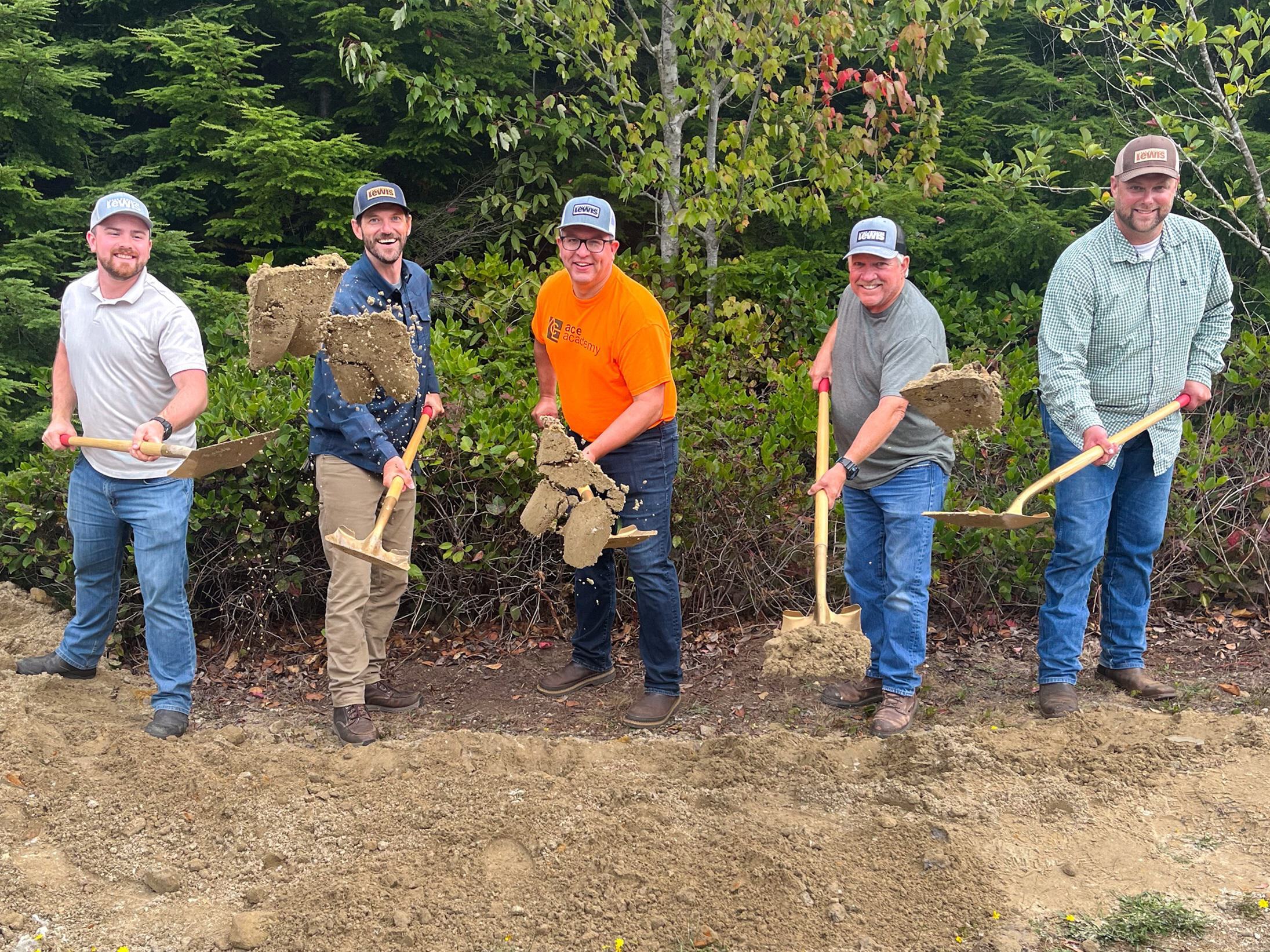
The Lease Crutcher Lewis team poses for a photo at the September 2025 groundbreaking ceremony at OCCC.
Supporting pathways to local jobs
OCATT is the centerpiece of a 2024 voter-approved bond to support CTE programs while also supporting deferred maintenance on other OCCC facilities.
For OCCC, the Center represents a major step forward in addressing a long-standing regional challenge: young people seeking training and career opportunities elsewhere. Students interested in trades education often travel to Salem, Portland, or beyond. Many don’t return to Lincoln County after completing their programs or finding work.
“One of the college’s goals is to give local students a place to learn a trade without having to leave the coast,” Walkup explains. “That way, they can build their skills, stay in the community, and strengthen the local workforce.”
The Center will also serve adults looking to reskill or upskill, whether transitioning careers, returning to school, or advancing within their field. Early engagement with industry partners such as Georgia-Pacific, local electricians, and small business owners helped shape the design to address critical workforce needs.
Employers will be able to partner with the college to develop specialized credentials or short-term training programs that fill gaps in the local labor market.
Built for the Oregon Coast
OCATT's design takes cues from the forested OCC Newport campus.
“The building is designed both inside and outside to express the Oregon coast community's connection to the coastal landscape, merged with the industrial nature of the training that will take place here,” says Corey Martin, principal designer for Hacker Architects, a regional leader in the design of mass timber buildings.
The entire structure will be built from mass timber, including a roof structure made from acoustic dowel-laminated timber, or DLT, a type of solid wood panel designed to reduce noise and improve sound quality in a space while keeping the natural warmth and beauty of exposed wood. The building’s façade, clad in metallic green panels, will be built to withstand the salt air and wind-driven rain while camouflaging OCATT into the forest surrounding the OCCC campus.
Openings and penetrations will receive extra protection, with the design minimizing windows that face the ocean to the southwest. The project is being built on sandstone within an ancient dune. While piles may not be needed for extra stability, site preparation and excavation are being carefully timed and managed to ensure the site pad has time to properly settle and stabilize.
Meeting students where they are
Inside the OCATT Center, students will find spaces built for learning, work and connection. The design calls for a commons and kitchenette where they can gather or grab a meal after class; showers and locker areas for those transitioning between jobs and coursework; and a meeting room where local employers can connect directly with students to offer mentoring, interview prep, and real-world insight.
In Lincoln County, the impact will extend far beyond the classroom walls, training a new generation of builders, technicians, and trades professionals who can learn, work, and thrive on the Oregon Coast.
For Whitehead, Walkup and Martin, the excitement lies not just in seeing the building completed, but how its uses adapt over time and how programs and users intersect.